


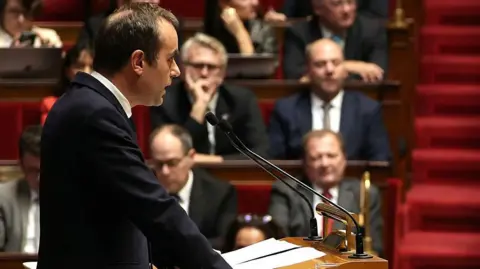
French Prime Minister Sébastien Lecornu has told lawmakers that he favors halting divisive retirement age changes implemented in 2023, ahead of important confidence motions later this week.
The modifications, which raised the retirement age from 62 to 64, were considered key policies in Emmanuel Macron's presidency.
"During autumn I will suggest to parliament that we freeze the retirement age changes until the next presidential vote," the Prime Minister stated to applause from progressive factions.
Lecornu was reappointed last week only four days after he left office, and requires the approval of progressive representatives in the assembly if his government is to survive.
Parliamentary Dynamics
Other factions on the right-wing and left-wing have called confidence votes on the cabinet, for Thursday morning and are calling for new elections.
The Socialists said they would be prepared to back the administration, but only if it guarantees a full halt of the president's retirement reforms.
"Unless he clearly state the words 'full and instant suspension of the retirement changes', it will be a vote of no-confidence," representative Laurent Baumel previously stated on national media.
"The decision rests in his political survival in his own hands. He understands what he has to do if he seeks to prevent being the government leader who leaves office every week."
Political History
The measures were finally passed by lawmakers in spring 2023, fewer than a year after the president was elected for a another term.
There had been months of political debate, strikes and street protests, and in the end the legislation had to go through without a parliamentary approval in the assembly using a legal procedure known as constitutional article 49-3.
Recently, Lecornu said it was something many French people recalled as a "political scar" .
Financial Implications
On recently he made it plain to MPs that halting the retirement changes would amount to 400 million euros in the medium term and a further billions in the presidential election year. This will have to be "balanced with other budget cuts," Lecornu stated.
Lecornu is France's third government leader in the recent period but even if he does survive he needs to pass a financial plan through the assembly that brings down a financial shortfall projected at 5.4 percent of economic output this year.
France's public debt in recent months stood at €3.4tn, or almost 114 percent of GDP, the third largest in the eurozone after the Greek economy and Italy.
Administrative Decisions
The Prime Minister has been one of Macron's strongest allies, so his decision to reverse course on such a contested measure shows how keen the head of state is to avert further political crisis.
A Nobel laureate, who was co-recipient of the prestigious award on this week, said earlier that he endorsed a suspension of the pension reform, because it would still involve a reduced impact than the instability that would follow another government collapse.


